Govern and Enforce
Apply AI-specific authority and policy to workloads routed through configured control paths.
- Policy Engine and Runtime Guardrails
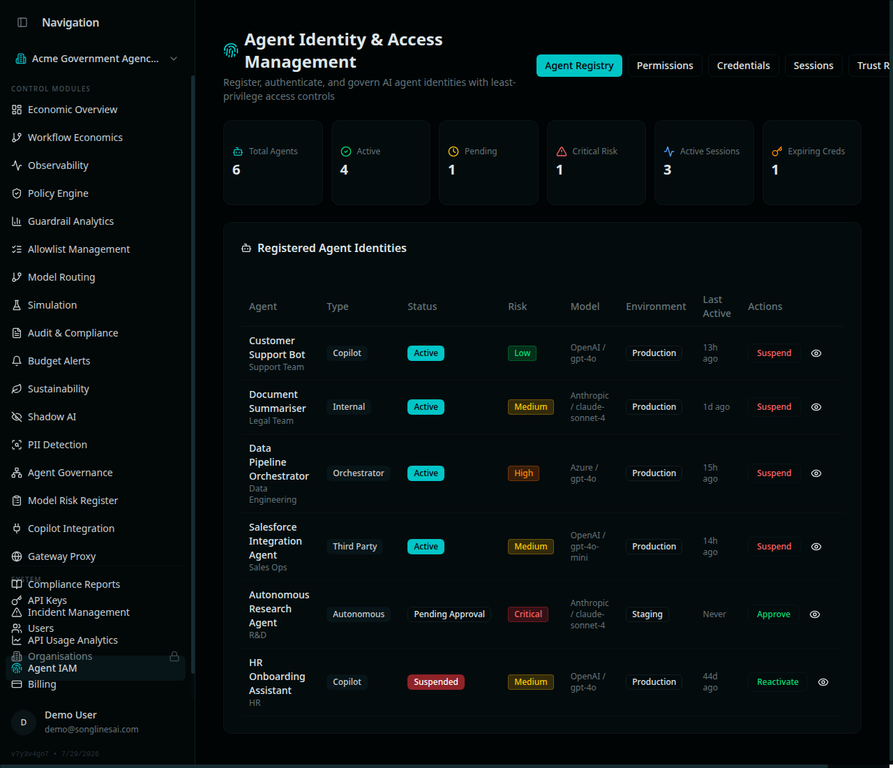
- Agent Identity & Access
- PII Detection and Human Review
- Budget Controls and Model Routing
Choose the trust boundary that fits your enterprise. Cetus AI supports multiple deployment patterns to match your risk appetite and existing architecture.
Ingest approved logs read-only and produce cross-stack governance evidence. No runtime policy decision.
Run the Policy Decision Point inside your environment; use Cetus AI management in Australia.
Deploy the complete platform in a dedicated customer tenant or private cloud environment.
Route selected AI workloads through the full managed platform where central enforcement is appropriate.
Evaluate AI-specific policy without replacing your API gateway. Songlines Control returns deterministic decisions that your existing orchestration layer can enforce.
Correlate source logs and policy decisions into one governance record. Songlines Control links request IDs to telemetry from Azure Monitor, AWS CloudTrail, SAP, and Salesforce.
Explore Regulatory Compliance Export →Use the capabilities your organisation needs while preserving one governance record across policy, evidence, value and enterprise integration. Availability and coverage depend on the selected deployment, connected systems and configuration.
Apply AI-specific authority and policy to workloads routed through configured control paths.
Capture activity, cost, risk and decision evidence from connected sources.
Value Control connects approved baselines, fully loaded cost, outcome evidence, attribution and finance validation before reporting risk-adjusted portfolio value.
Forecasts and operational estimates are not presented as realised ROI. Finance and business validation remain required.
Review Value Control →Work with the systems the enterprise already owns rather than requiring replacement.
Provider connections require customer credentials, source mapping and validation for the selected environment.
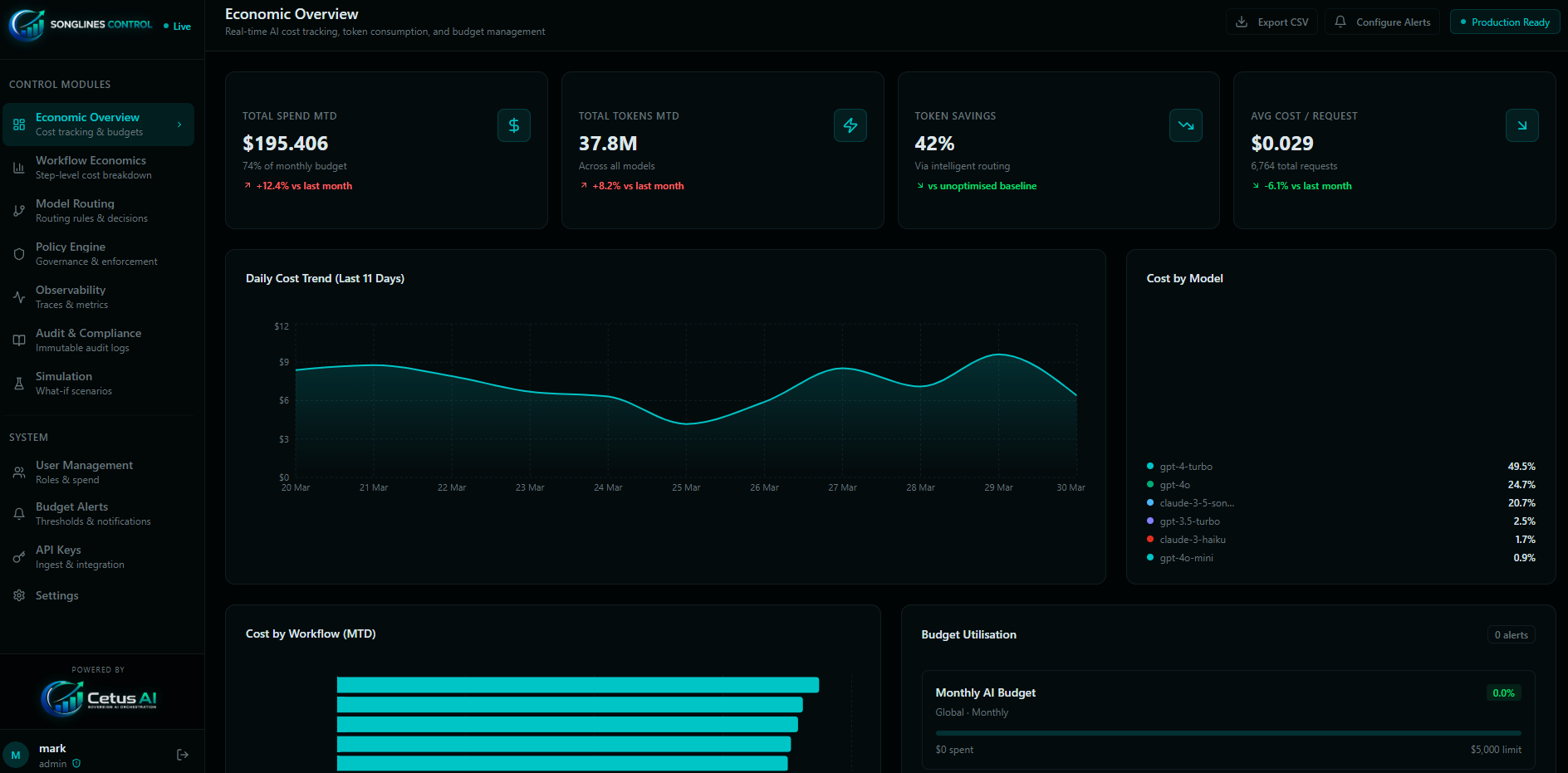
The Economic Overview dashboard attributes the telemetry received from configured sources by model, workflow, team and user. Cost calculations use the selected provider rates and available token data; completeness depends on source coverage, mapping and customer configuration.
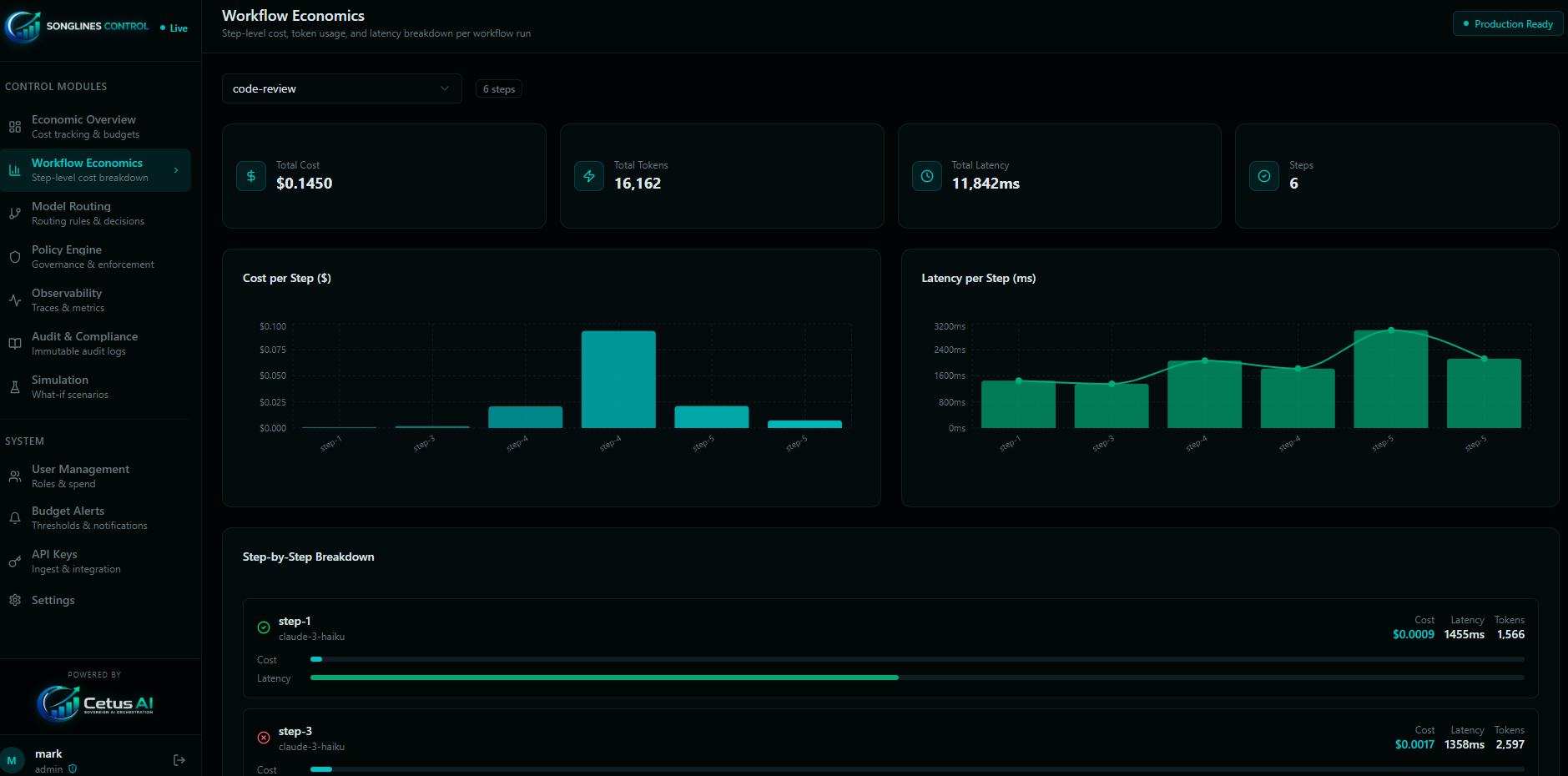
Workflow Economics uses mapped telemetry to show available step-level cost and latency data for a selected workflow. The resulting breakdown supports customer investigation of potential optimisation opportunities.
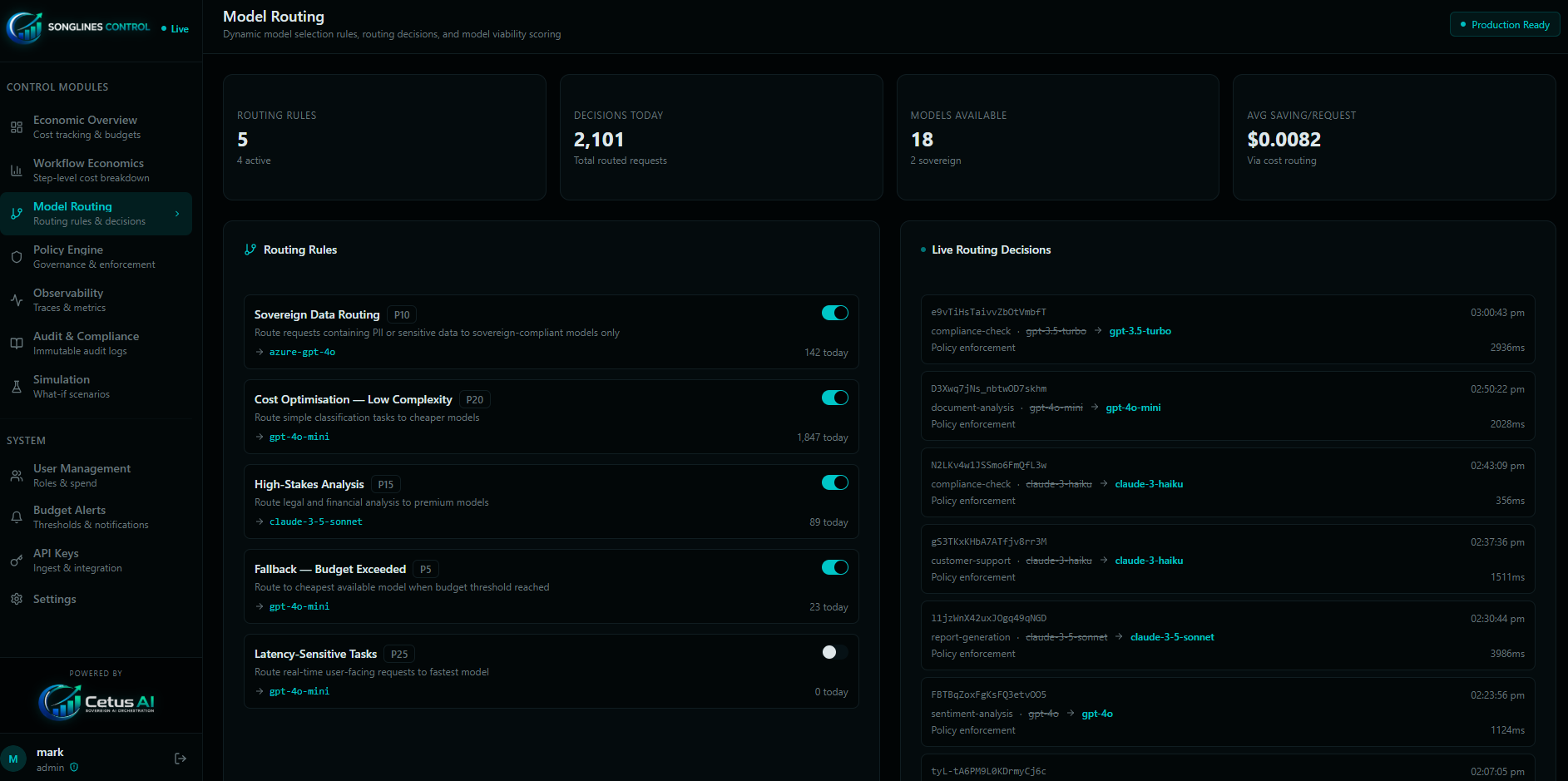
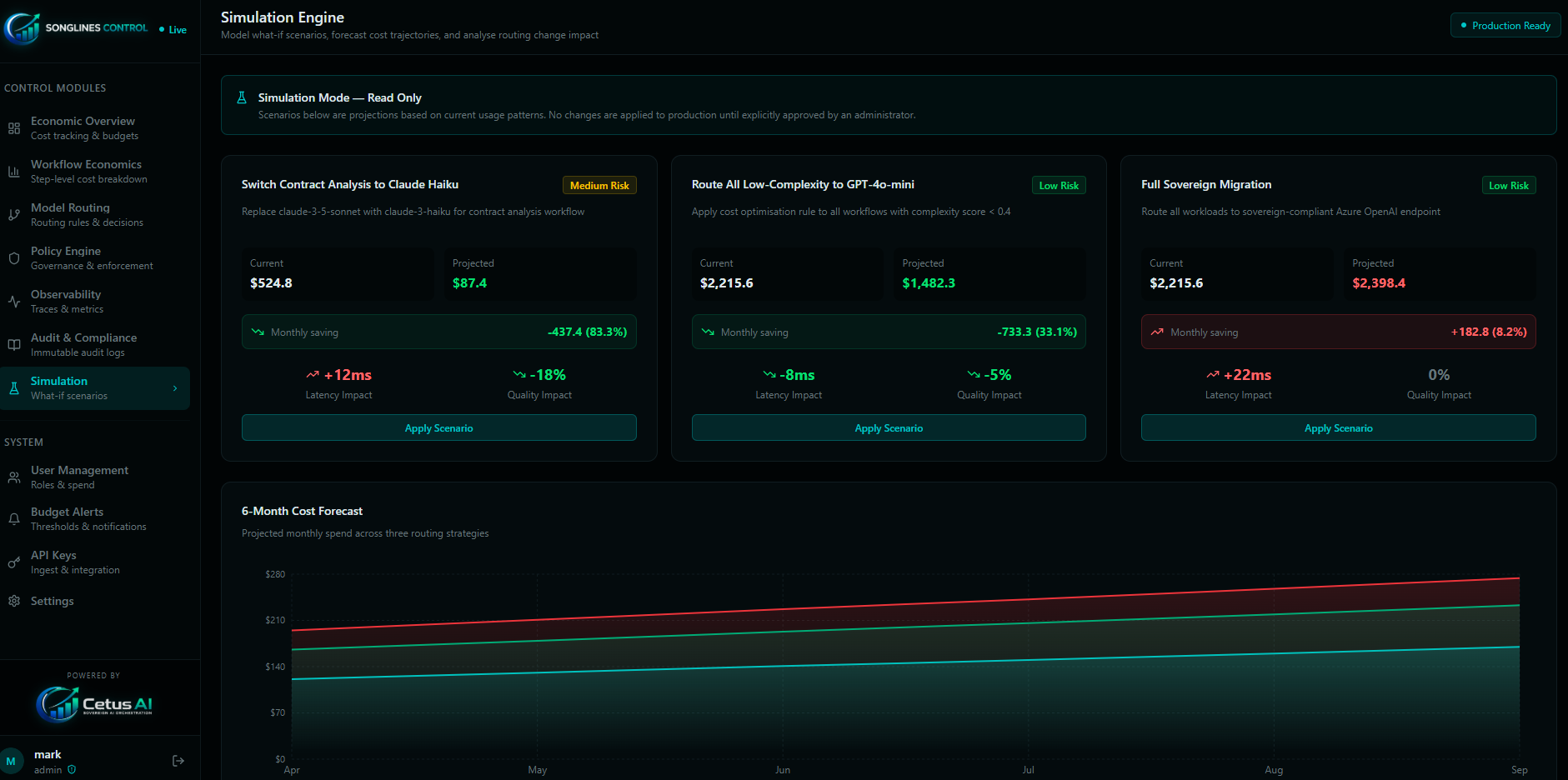
Model-routing scenarios compare a current workload with lower-cost or policy-preferred alternatives. Actual savings and operational outcomes depend on workload, quality, latency, provider, policy and implementation constraints.
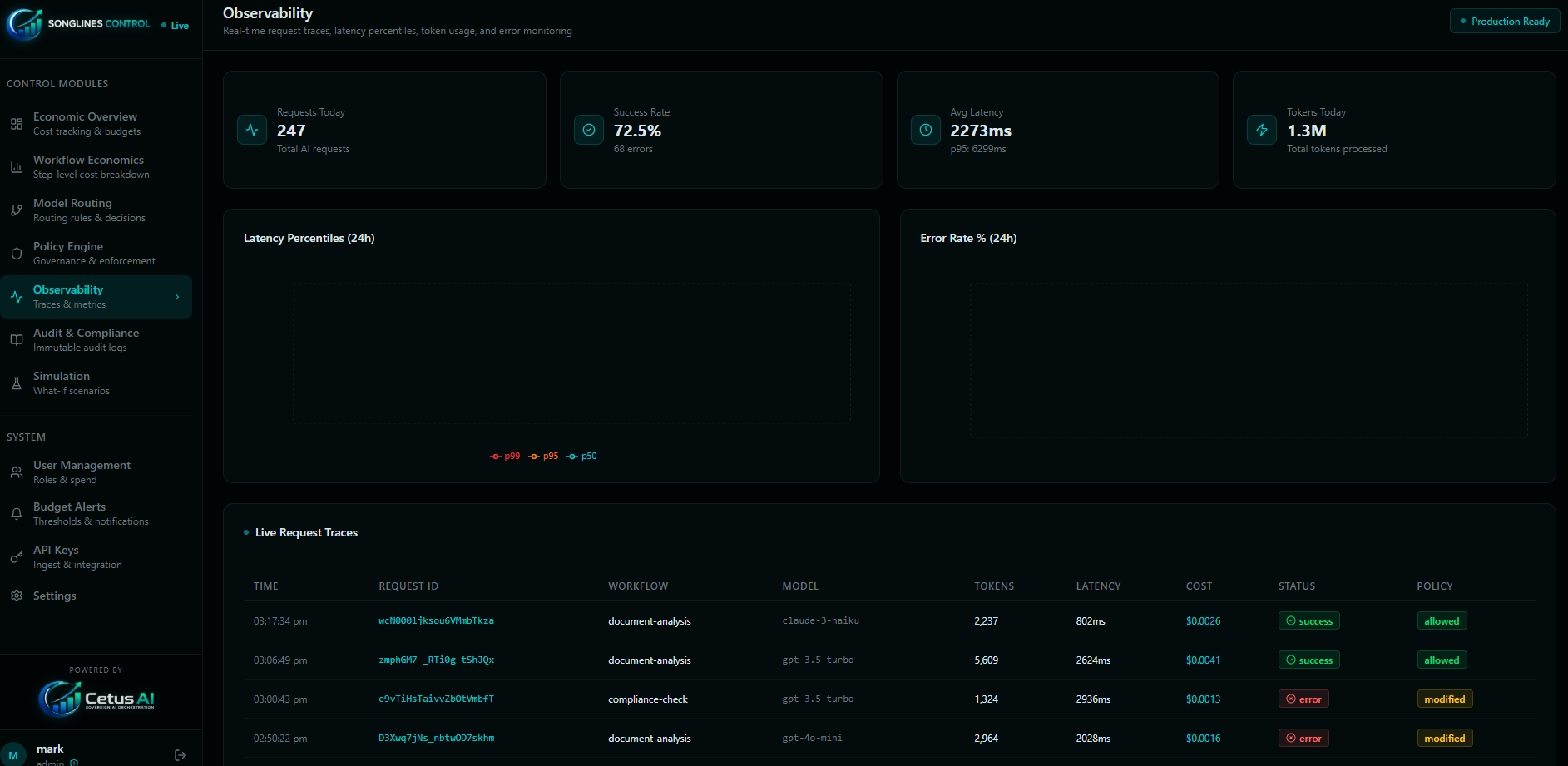
The Observability module presents latency, error, success and token-throughput telemetry received from connected sources. Attribution and completeness depend on the identifiers and fields supplied by each configured workload.
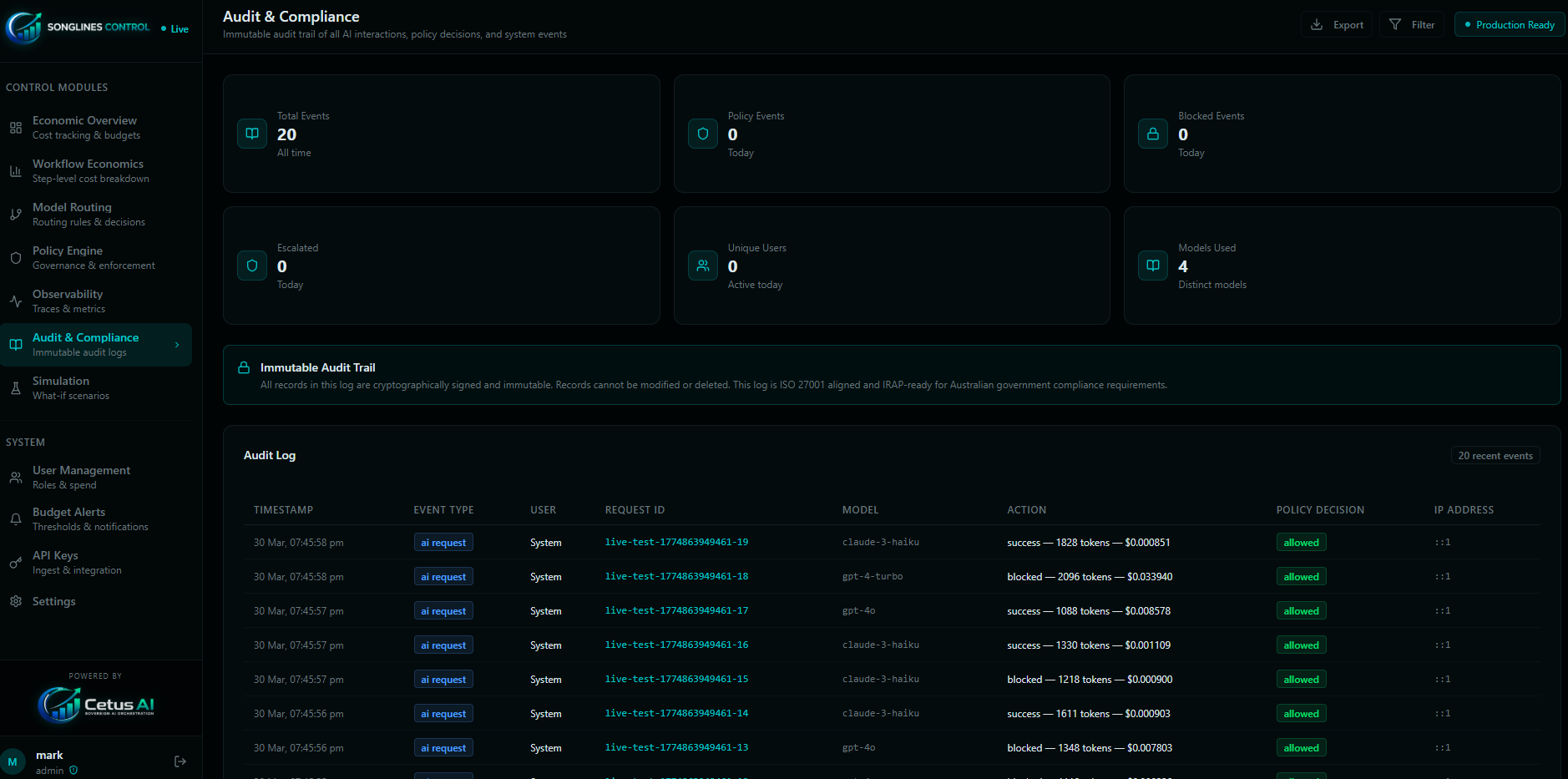
Requests routed through configured control paths can generate signed, append-only records containing the fields available from the workload and policy decision. These records support audit and compliance review when combined with the customer's legal, risk, retention and operating controls.
The Simulation Engine models the potential cost and performance impact of routing strategy changes before production use. Results depend on the available telemetry, selected assumptions and customer review of risk, latency and quality constraints.
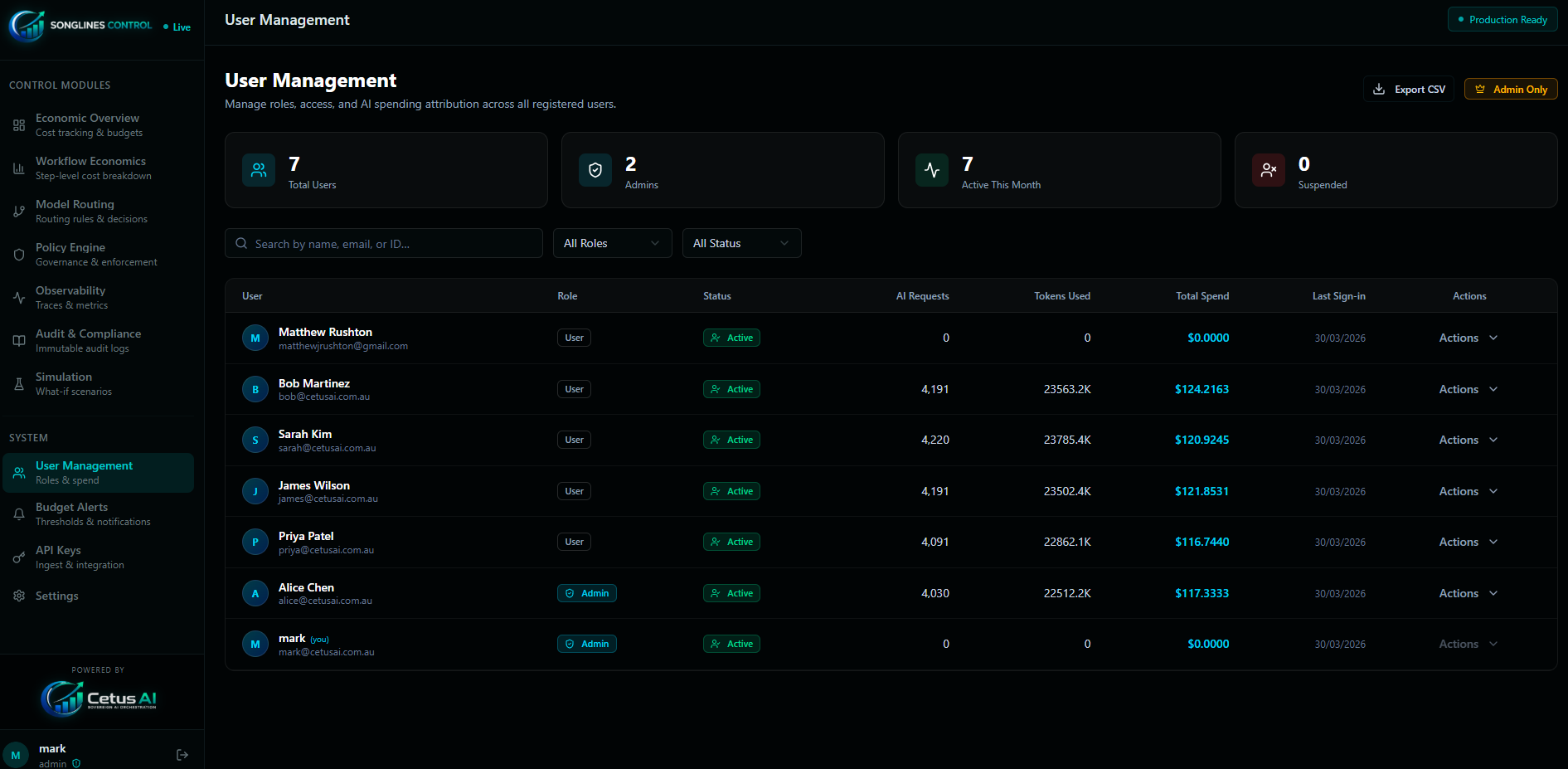
User Management presents identity, usage and cost data received for registered users and connected workloads. Administrators can assign roles, review attributed activity and suspend platform accounts under the customer's access process.
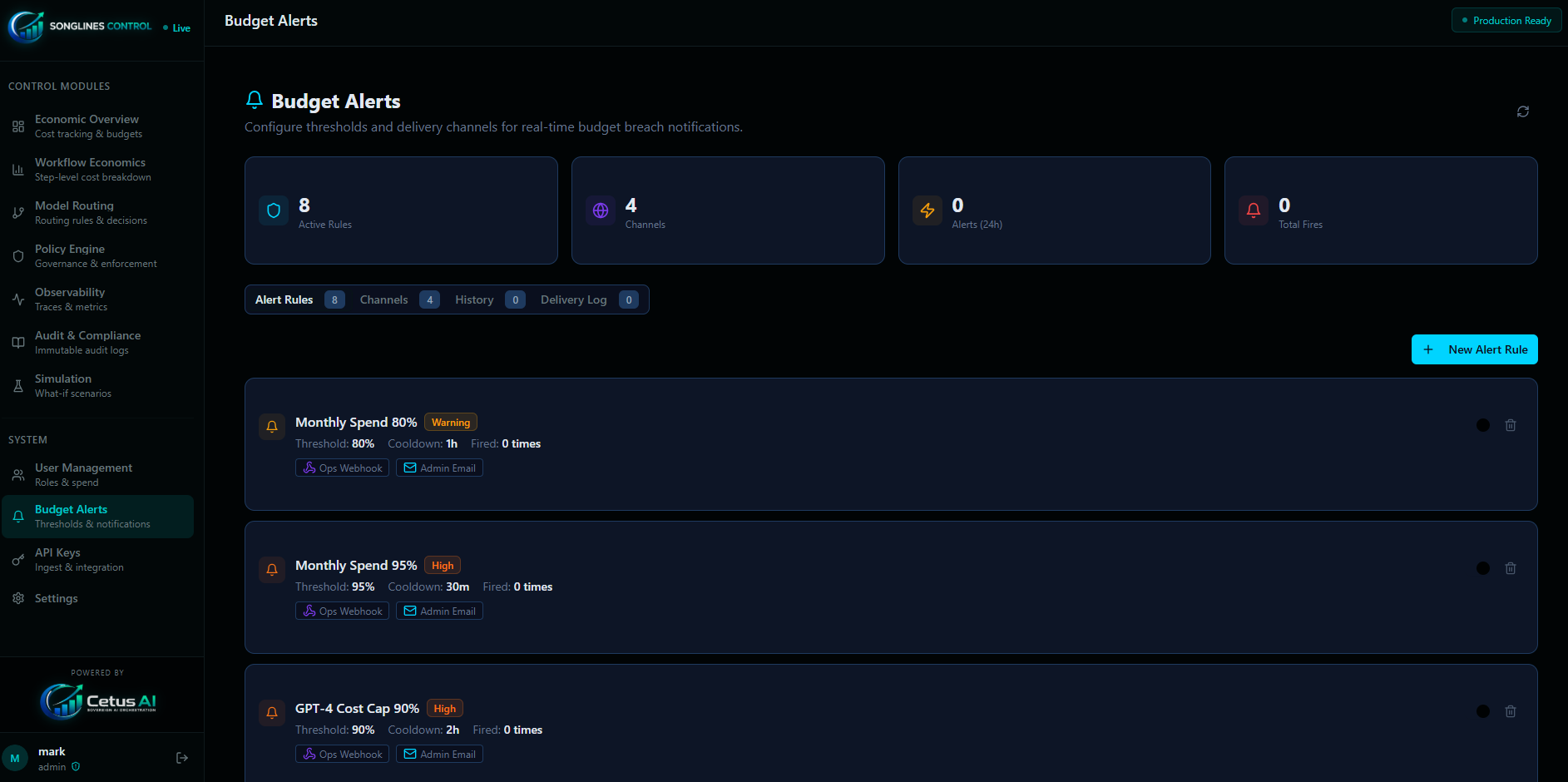
Configure alert rules scoped to model, workflow, team, or organisation-wide with custom dollar thresholds. Deliver alerts via HMAC-signed webhooks to PagerDuty, Slack, or Teams — or via email to your finance team. Cooldown windows prevent alert fatigue once a threshold is crossed.
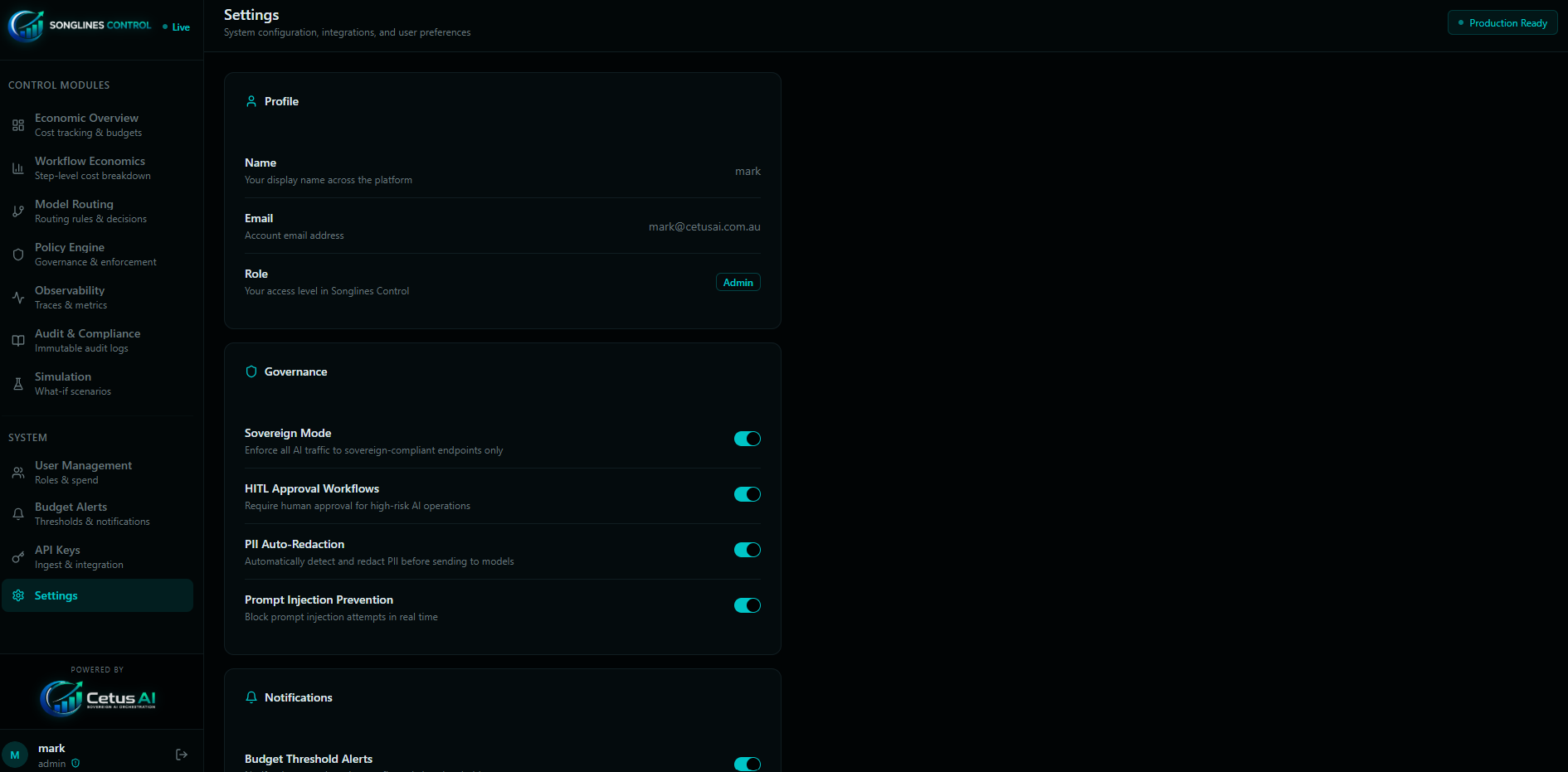
The Settings screen configures residency-aware routing, PII detection and redaction, and human-review gates for the workloads covered by the selected enforcement path. Customers remain responsible for classification rules, route coverage, exceptions and connected-provider configuration.
Organisations are deploying copilots, orchestrators, autonomous agents and third-party integrations across multiple environments. Agent IAM provides identity, authentication and authorisation controls for agents registered within the configured Songlines Control boundary.
Requests routed through a configured Songlines Control enforcement path can be evaluated against applicable policy before provider execution, with response checks applied where configured. Customers remain responsible for route coverage, direct-provider access and exception controls.
Configure spend thresholds by organisation, team, workflow or user. Covered requests can be blocked or routed to an approved alternative when a configured threshold is reached; effectiveness depends on route coverage and policy configuration.
Residency-aware routing can restrict covered requests to approved endpoints and block a route that conflicts with the configured boundary. The effective residency position depends on the deployment pattern, connected providers, data flows and customer configuration.
Configured detection and redaction rules can identify selected personal-information types on covered outbound paths before provider submission. Customers remain responsible for classification quality, coverage, exceptions and validation in their environment.
Define approved model policies for teams, workflows or users on covered control paths. Direct-provider access and unmanaged tools require complementary customer controls; Songlines Control does not claim universal coverage outside the configured architecture.
Configured prompt-integrity rules can flag, redact or block recognised adversarial patterns on covered inbound requests. Detection is one control within a broader application-security and model-risk approach.
HITL Approval Workflows require a designated human approver to review and authorise high-risk AI operations before they are executed. Define which workflows, models, or request types require approval, set escalation paths, and maintain a full approval audit trail — ensuring human oversight is embedded in your AI governance framework, not bolted on afterwards.
Requests routed through the configured enforcement path are evaluated against applicable policy before provider execution. Customers remain responsible for ensuring route coverage, limiting direct-provider access and managing authorised exceptions.
A lightweight telemetry pattern can be added alongside an existing AI response path. Implementation scope and timing depend on source quality, identity mapping, architecture and customer validation.
Generate an API key scoped to the approved application, workflow or team under the customer's access-control process.
Add a POST to /api/ingest after an AI response and map the available model, token, latency, cost and workflow fields.
Validate the received telemetry, attribution fields and cost assumptions before using dashboard outputs in governance or finance review.
TypeScript and Python SDK patterns are available. Provider and workload compatibility must be validated against the selected architecture and source data.
Deploy Songlines Control® in the model that matches your organisation's security classification, data residency requirements, and procurement constraints.
Hosted in Microsoft Azure cloud and managed by Cetus AI. The selected Azure region, data flows, subprocessors and shared operational responsibilities are confirmed during architecture and security review.
Deployed into a supported customer cloud tenancy. Provider, region, service compatibility, isolation boundaries and operating responsibilities are validated during architecture and security design.
Customer-hosted and isolated deployment patterns can support workloads with elevated security requirements, subject to architecture validation and the customer's security assessment.
Songlines Control® is designed from day one for the frameworks that matter to Australian enterprise and government — not bolted on after the fact.
Supports customer privacy controls with configured PII detection and redaction, residency-aware routing and governance records for covered interactions.
Supports APS transparency, accountability and human-oversight processes through configurable evidence and review workflows.
Supports AI Management System certification with documented controls, risk records, and audit evidence exportable in a single click.
ACSC mitigation strategies supported through application control, patch management visibility, and privileged access management via RBAC.
Provides technical controls and evidence that can support customer assessment against applicable ISM requirements; coverage depends on the deployed architecture and operating controls.
Australian deployment options and customer-hosted patterns can support data-residency requirements. Boundaries depend on the selected deployment, connected providers, data flows and customer configuration.
Produces AI-emissions estimates and reporting inputs that can support a customer's climate-reporting process, subject to methodology, materiality, data quality and assurance review.
Supports AI inventory, risk assessment and sanctioned-use workflows that can help agencies operationalise applicable policy requirements within their governance model.
Purchased AI services may contribute to an organisation's Scope 3 inventory depending on its reporting boundary and methodology. Songlines Control® provides usage-based estimates and reporting inputs for customer review; classification, materiality and assurance remain the customer's responsibility.
Covered interactions can be attributed by team and model and mapped to a CO₂e estimate. The resulting data can support customer reporting and review, subject to methodology, materiality, source completeness and assurance requirements.
Model-routing scenarios compare eligible alternatives using selected cost, quality, latency and policy assumptions. Realised financial and emissions outcomes require customer measurement and validation.
Where a validated cache response avoids a provider call, provider inference and associated usage charges may be reduced. Measurement boundaries and infrastructure overhead must be defined.
Every organisation begins from a different point. Start with an assessment, validate value through a focused pilot, or design an enterprise deployment around your existing architecture.
Identify governance gaps, Shadow AI exposure, evidence readiness, and the immediate controls your organisation should prioritise.
Take the Gap Assessment →Instrument a representative workload, validate visibility and evidence outputs, and build a practical implementation roadmap.
Explore Professional Services →Define deployment boundaries, integrations, policy decision points, evidence requirements, and rollout sequencing for your environment.
Book an Architecture Review →"Your AI systems are already running. The question is whether you're in control of them."
Scope a representative workload, confirm evidence and control requirements, and define delivery timing after source, security and architecture discovery.
Choose the experience that best matches the question you want to explore. Each demonstration opens as a standalone Songlines Control experience in a new browser tab; it is not embedded within cetusai.com.au.
Create a 30-day synthetic operating environment and follow an illustrative journey from AI activity through governance evidence and value review.
Open Guided Simulator — new tabExplore synthetic portfolio records across Forecast, Observed, Attributed, Finance validated and Risk adjusted states.
Finance validation remains an authorised Finance decision. Demonstrated attribution does not independently establish causation or realised ROI.
Open Value Control — new tabTake a guided 15-step, approximately seven-and-a-half-minute walkthrough from AI operations to accountable value decisions, with audio controls.
Open Narrated Tour — new tabAll organisations, identities, workflows, events, costs, benefits, incidents, decisions and outputs shown are synthetic and illustrative. FinOps evidence is simulated, local to the demonstration environment and read-only; no external Finance or FinOps account is connected or changed. Benchmarks are directional and source-labelled, not predictions or financial advice.
Value Control keeps observed change, attribution, Finance validation and risk adjustment distinct. These demonstrations do not independently establish causation, realised ROI, compliance or assurance.
Demo access updated September 2026. External experiences may use session cookies and security controls; no iframe is used.
Follow a connected walkthrough across Teams, Control, Evidence Fabric and the integrated Value Control module. See how configured workloads can be governed, observed and reviewed without replacing the enterprise systems already in place. All demonstration records are synthetic and illustrative.
17:23 · Updated September 2026 · Australian English captions available